“You can’t always be perfect. You just have to keep going.”
~ Mikaela Shiffrin, Multi-Olympic Gold Medal American Alpine Skier (1995-xxxx)
- The start of 2026 saw the resumption of the rally that closed out 2025 with a modest broadening beyond the technology sector.
- Uncertainty continues to create moderate levels of periodic volatility in the equity market, while the Federal Reserve (the “Fed”) debates their next policy moves.
- Mid-term elections likely will add further to market volatility as investors search for answers regarding the global investment landscape.
Every four years the world gathers in a frigid region to celebrate winter with a sports showcase that highlights the remarkable athletes that dedicate their lives to their unique disciplines. The Winter Olympics concluded on February 22, and this year the medal count was similar to many previous games, with Norway leading the way and United States and Italy following behind. Overall, 29 countries have won at least one medal, reflecting the diverse set of skills that enable nations to compete at the highest level. Similarly, the opening months of 2026 have extended the constructive momentum that carried markets through the end of 2025, with a gradual broadening of performance beyond the mega cap technology names that previously dominated returns. Investors continue to navigate an environment of persistent uncertainty — from the Fed’s evolving policy stance to shifting dynamics in Washington during a midterm election year — that is contributing to periodic bouts of volatility. Diversification globally is always an important consideration when considering the vastly different impacts of country-specific issues at times.
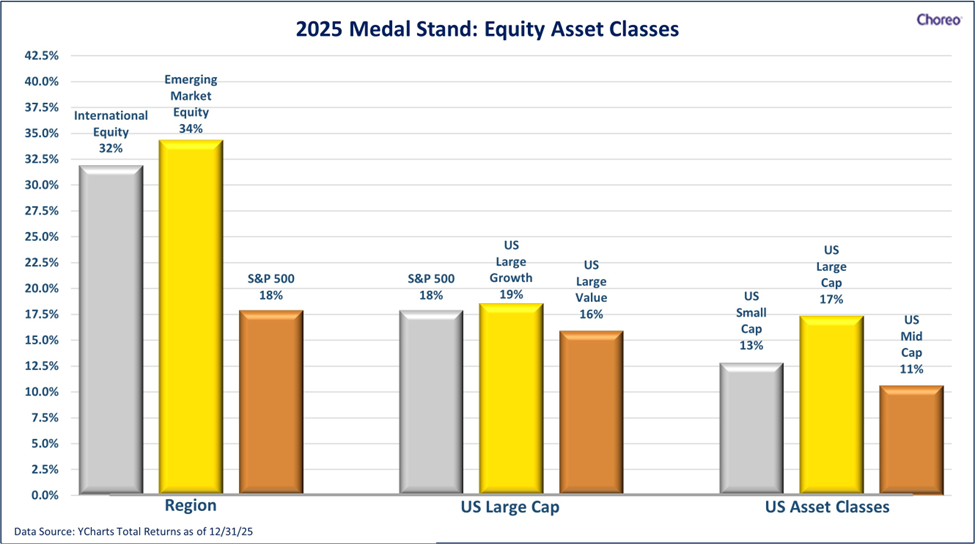
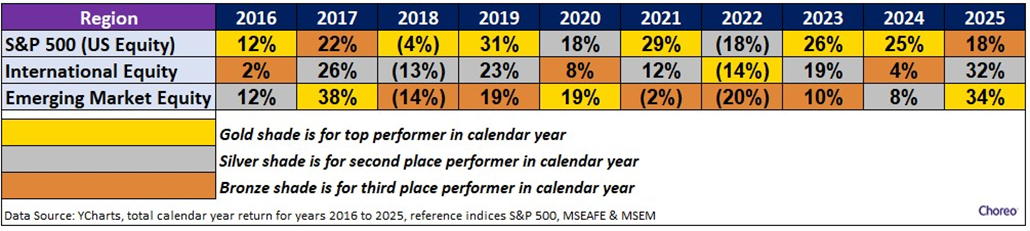
To help make sense of this complex financial backdrop, we turn to an unexpected but fitting metaphor: the Winter Olympics. Across disciplines ranging from endurance skiing to high precision events, each sport rewards a unique blend of skill, preparation, and competitive advantage. The global economy is no different (nor is our portfolio construction process). Certain regions tend to specialize with industries that are prone to cluster in specific nations. Capabilities are often different as nations spend more resources on training facilities, technology and more. Understanding these “event specialties” provides a powerful framework for thinking about global diversification — not merely as a risk management tool, but also as a methodology to highlight global strengths capable of performing in a wide range of conditions. 2025 was a year in which the global indices generally outperformed the U.S. This month we look at some of the regional market specialties and compare the Olympic strength. In the spirit of the Olympics, the chart below shows 2025 market performance by region.
 Past performance, Gold Silver Bronze is not indicative of future results.
Nordic Nations: Endurance, Resilience, and Sustainable Strength
(Cross country skiing, biathlon, long distance events)Nordic nations have tended to excel at the most demanding endurance disciplines — a fitting parallel to their economic profiles. These countries, and the companies within, have tended to benefit from strong human-capital development, robust governance standards, and long-term fiscal stability. Like an elite cross-country skier, their advantage lies not in bursts of speed but in durability, consistency, and the ability to perform through difficult terrain. Social infrastructure, political stability, and a generally reliable policy environment has impacted these regions.
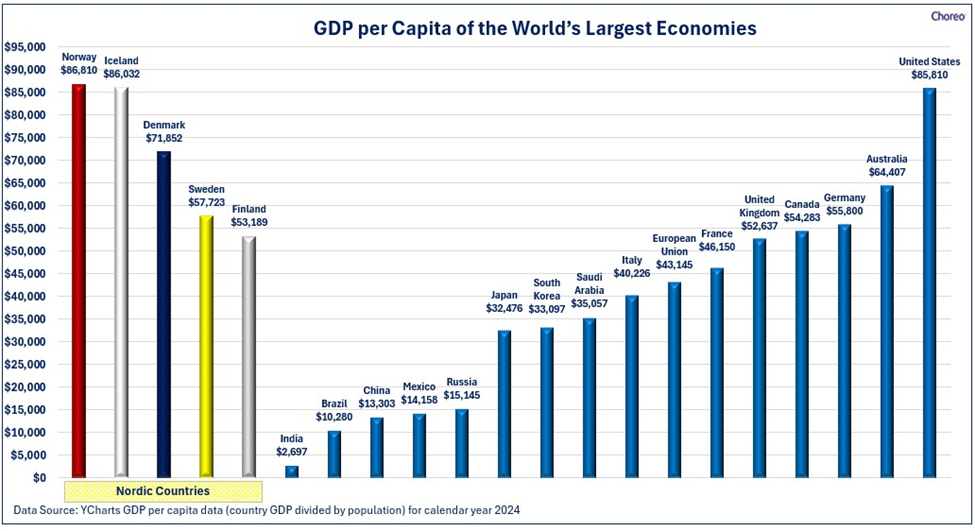
Companies such as Norsk Hydro (renewable intensive aluminum manufacturing), Volvo (global leader in safety driven automotive engineering) and H&M (multinational retail with broad global reach) lead markets. Nordic nations tend to be amongst the highest in terms of gross domestic product per capita in the world, as shown in the 2024 graph below.
Alpine Nations: Precision, Stability, and High‑Skill Manufacturing
(Downhill skiing, slalom, ski mountaineering)
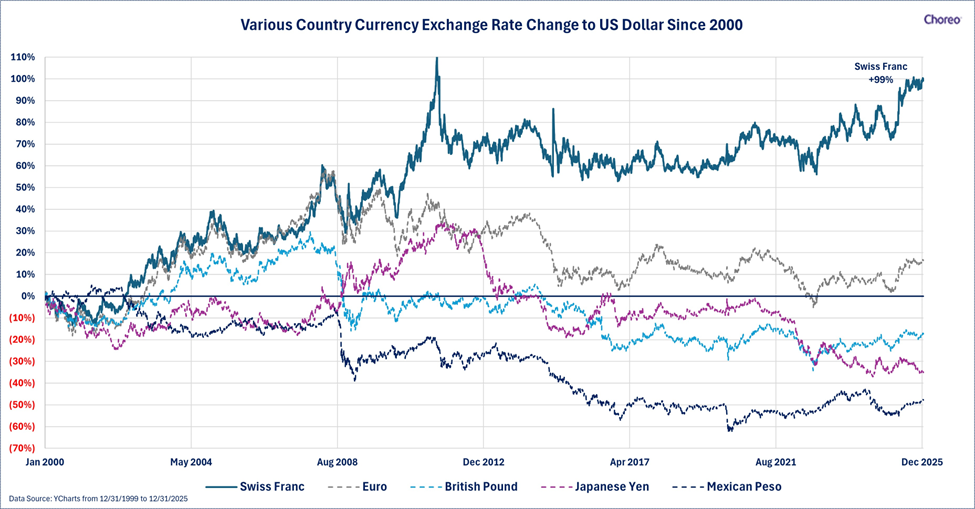
The Alpine region — Switzerland and Austria in particular — have excelled in the competitions known for precision and technical mastery. That same commitment to craft and meticulous engineering defines the region’s economic profile. These countries continue to lead the world in high precision manufacturing, pharmaceuticals, and stable financial systems. Precision mechanical engineering and advanced manufacturing, and global strength in pharmaceutical and medical technology, anchored by conservative financial systems and safe-haven currencies have buoyed the economic production of these regions. Nestlé (diversified global consumer products), Roche & Novartis (pharmaceutical and biotech innovators) and Swatch Group (precision timepiece engineering and luxury craftsmanship) highlight some of the region’s strengths, while the chart below illustrates the strength of the Swiss Franc over time, particularly when compared to the Euro.
North America: Power, Innovation, and Scalable Growth
(Snowboard halfpipe, hockey, speed skating)
Explosive, fast-moving Winter Olympic events mirror the defining characteristics of the North American economy. The U.S. remains the world’s innovation engine — supported by deep capital markets, a thriving entrepreneurial ecosystem, and the ability to scale breakthrough technologies rapidly. Canada adds infrastructure and resource depth, while Mexico maintains a strong manufacturing background to round out the region’s competitive advantages. Together they possess unmatched global leadership in technology and innovation, scale benefits across sectors, and deep and highly liquid financial markets. Globally, some of the largest companies in the world are based in the U.S. such as Microsoft, Nvidia, and Amazon on the technology and consumer side, and UnitedHealth on the healthcare side. Meanwhile, Canada boasts some of the most important infrastructure companies in the region with Canadian National Railway and Canadian Natural Resources, and Mexico is home to a highly skilled manufacturing industry that produces products such as Coca-Cola and automobiles and parts for Nissan and GM, amongst others.
Continental Europe: Coordination, Manufacturing Depth, and Balanced Strength
(Relay events, bobsled, synchronized team competitions)
Continental Europe has done well in synchronized, team based sports — a metaphor for its deeply interconnected economic structure. German engineering, French consumer brands, Dutch semiconductor tooling, Spanish and Italian manufacturing, and the UK’s services economy together form a diversified, coordinated growth engine. A broad industrial base supported by engineering, category-defining luxury and global consumer brands, and strong healthcare and consumer staples sectors provide a defensive balance. ASML Holding N.V. (a global leader in advanced semiconductor manufacturing equipment), Siemens (automation, electrification, and industrial innovation), Moet Hennessy Louis Vuitton (global luxury conglomerate), and AstraZeneca & Unilever (resilient healthcare and consumer products brands) lead the way amongst European competitors.
Asia: Technical Mastery, Precision at Scale, and Rapid Adaptation
(Figure skating, short‑track skating, ski jumping)
Asia’s Winter Olympic strengths have tended to be in disciplines requiring precision, speed, and the ability to adapt quickly. The region is an economic force in robotics, semiconductors, Electric Vehicles (EVs), battery technology, and digital consumer platforms. Each major Asian economy contributes a unique specialization to the broader regional “team.” Leadership in advanced manufacturing and precision engineering, dominance in global semiconductor supply chains, and the rapid innovation cycles in EVs, batteries, and digital ecosystems can all be found regionally. Toyota, Sony, and Keyence in Japan lead in advanced manufacturing and robotics. Samsung Electronics and Taiwan Semiconductor Manufacturing Company in Korea and Taiwan respectively, are key players in the global semiconductor supply chain. And China and Southeast Asia lead EV and renewable energy innovation with companies such as BYD Company, Contemporary Amperex Technology Company Limited, and Sea Limited.
Global Investing
Just as medal counts are shaped by a mix of sprint events, endurance tests, and skill based competitions, long term investment outcomes are driven by diverse regional contributions. No single region provides all the attributes of a resilient portfolio. A diversified mix of regional strengths enhances resilience and provides a more reliable path to long term success by reducing dependence on any one part of the global economy.
Conclusion
2025 was a year defined by evolving expectations, uncertainty, and moments of resilience — yet markets proved adaptable and closed the year with constructive momentum. As we move deeper into 2026, the Winter Olympics offered a timely metaphor: the strongest teams are built not on a single skill, but on a balanced set of capabilities working in harmony.
By blending regions with endurance, precision, scale, coordination, and technical mastery, investors can assemble portfolios capable of performing across a wide array of market environments when viewed over time. Diversification is not simply a defensive posture — it is the investor’s version of building a complete Olympic team.
Please reach out to your Choreo advisor with any questions.
Disclosures
The performance numbers displayed herein may have been adversely or favorably impacted by events and economic conditions that will not prevail in the future. Past performance does not indicate future results and investors may experience a loss. The indices discussed are unmanaged and do not incur management fees, transaction costs or other expenses associated with investable products. It is not possible to directly invest in an index.
Opinions are expressed as of the date indicated, are subject to change and are based on sources considered reasonable by Choreo.