“The first half rewards preparation; the second half reveals discipline.”
~ Unknown
Markets have moved higher through the first half of 2026, shaking off geopolitical headlines even as the rally has become more selective.
The AI investment cycle remains one of the most important forces in markets, with the scale of spending and its concentration largely dictating market leadership.
Central banks are no longer moving in one direction together. The Fed, ECB, and Bank of Japan are facing different economic realities, which may increase currency, rate, and regional return differences.
As we move into the second half of the year, the objective is not to predict every headline, but to keep portfolios aligned with long-term goals while recognizing that the range of outcomes has widened.
Group Stage to Knockout Round
One of the largest sporting events on earth has just concluded with Spain emerging as the 2026 FIFA World Cup Champion. The event, as always, was filled with thrills, disappointments, controversy, and surprises. It is a fitting backdrop for markets at the mid-year mark. The first half of 2026 looked a bit like the group stage. There were plenty of possible outcomes, a few surprises, and a fair amount of noise along the way. Despite that backdrop, markets generally found a way to move higher. Staying invested through uncertainty has mattered.
Similarly to any sporting event, acknowledging that past performance does not indicate future results, the second half may look different. The field is narrowing. In soccer, that means fewer teams and less room for mistakes. In markets, it means a smaller group of stocks, sectors, and themes have been doing an outsized share of the work.
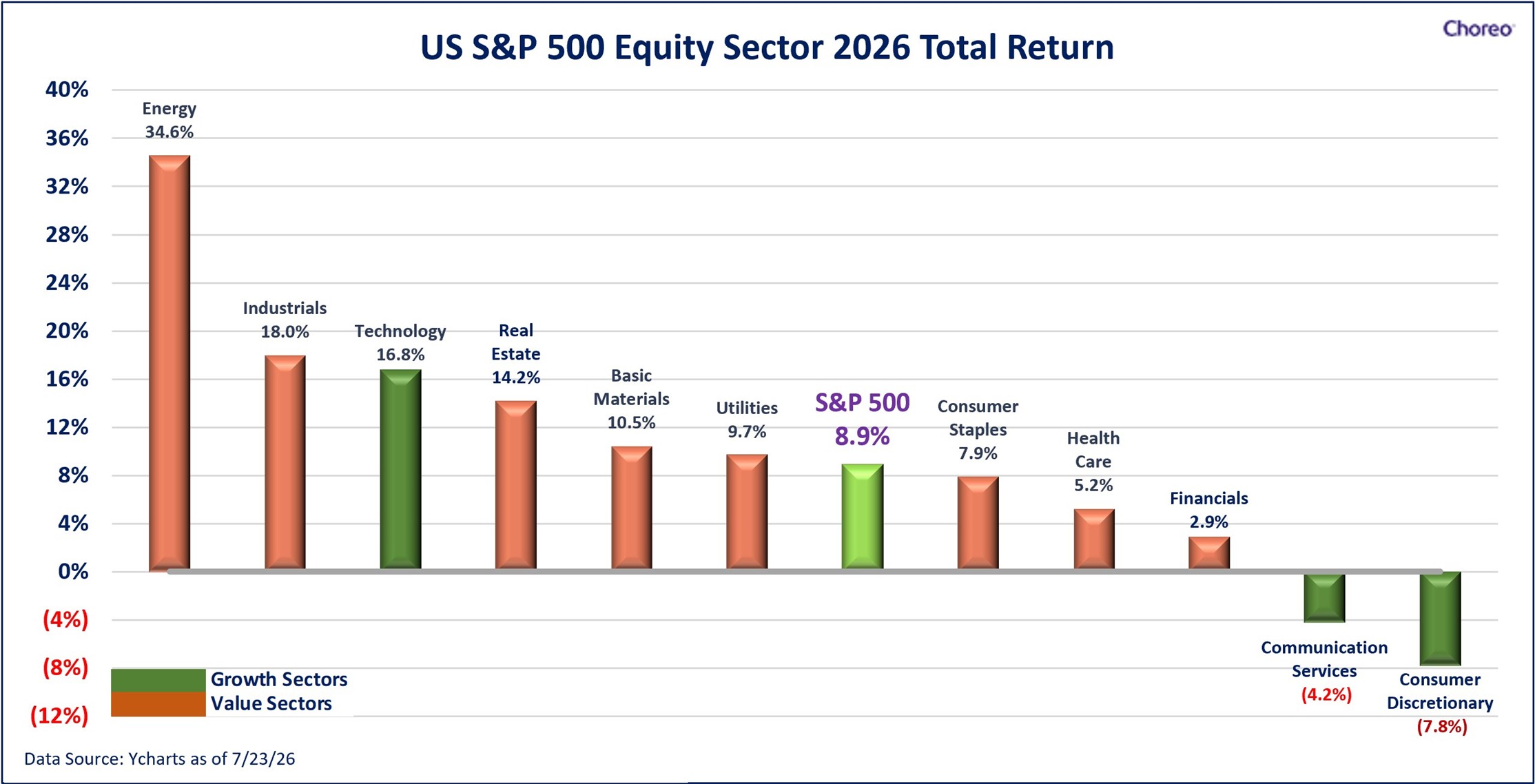
The themes we have discussed in recent months largely remain in place: higher-for-longer rates, a narrower set of market leaders, AI spending, Geopolitics and a market environment where selectivity matters to name a few. The chart below demonstrates that even some of the recent winners such as technology have given way to geopolitically- driven sectors such as energy.
Mid-Year Global Equity Market Update
U.S. equities delivered a strong first half of the year. The S&P 500, Nasdaq Composite, and Dow Jones Industrial Average all moved higher, supported by resilient earnings, ongoing AI-related investment, and an economy that has continued to expand even as parts of the data have softened. That said, the headline return only tells part of the story. Much of the strength has been concentrated in areas tied to semiconductors, AI infrastructure, energy, defense, industrials, and select financials. By contrast, more rate-sensitive or consumer-linked areas have had a more difficult time keeping pace. The path of performance this year has been wildly volatile with a meaningful selloff earlier in the year in some areas, followed by very significant improvements.
When a smaller number of companies account for a larger share of returns, the market may become more sensitive to disappointment from those companies. Artificial intelligence remains central to current market themes. The spending cycle around data centers, semiconductors, power infrastructure, connectivity, and compute capacity is large enough to influence corporate earnings, credit markets, and investor psychology. In many ways, the AI buildout is no longer just a technology story. It has become an economic and capital markets story.
The challenge is that expectations have also moved higher. Investors are increasingly asking not only whether AI spending will continue, but whether future earnings will justify the valuations attached to many of the beneficiaries and what the return on investment will be from the hundreds of billions of dollars flowing into this exciting space. This distinction matters. New technologies often create enormous long-term value, but the path from innovation to investment return is rarely straight.
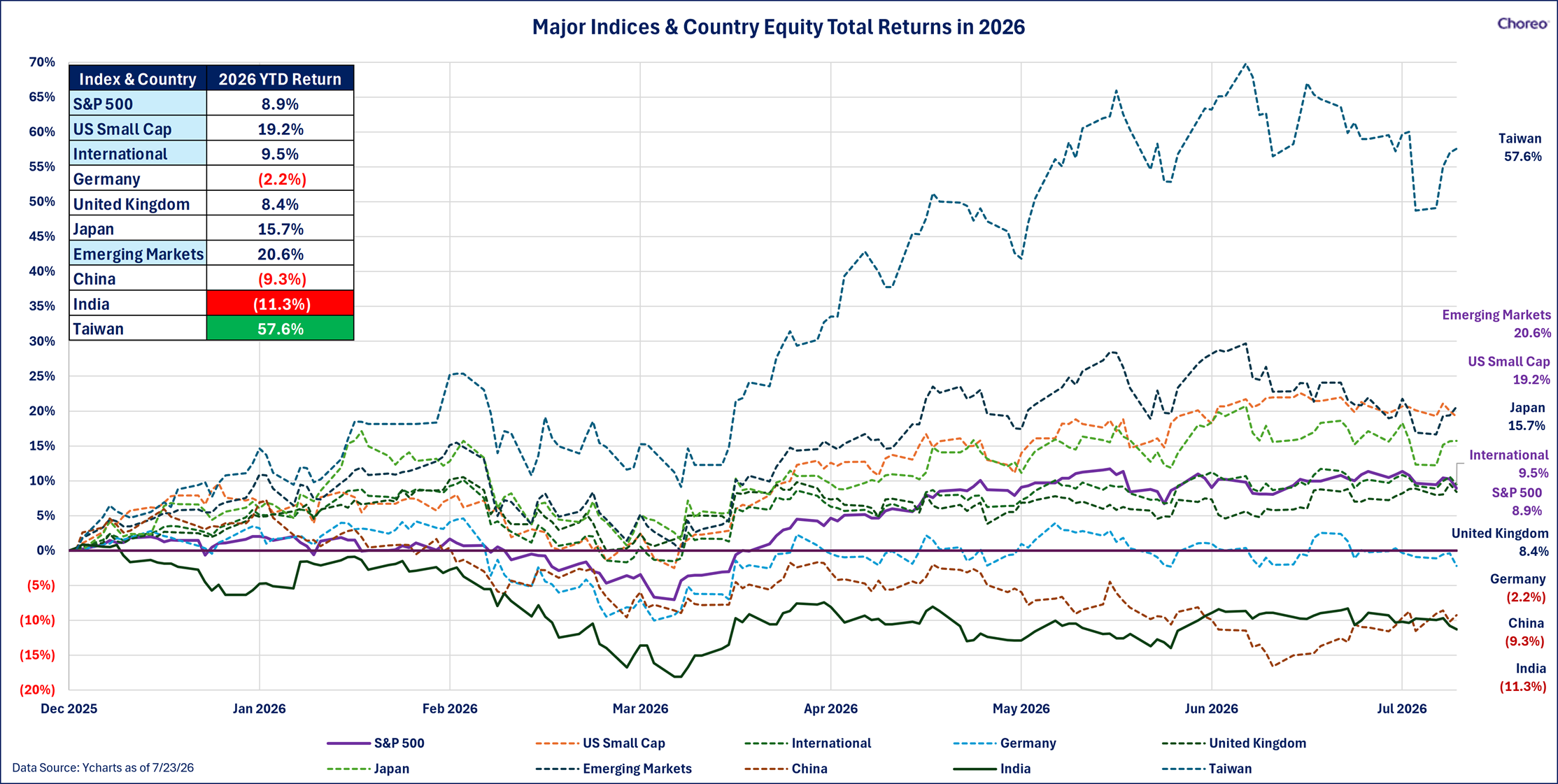
Outside the U.S., the backdrop is not too dissimilar — growth remains constructive but uneven. However, international markets have benefited from different (and often more attractive) valuation starting points, different sector compositions, and in some cases, more favorable local policy dynamics. Emerging markets have been standout performers in the first half of the year and continue to offer diversification benefits because of their unique characteristics. The chart below shows performance for key global markets and several key individual countries. Emerging markets delivered strong performance, led by Taiwan, which benefited greatly from its high concentration in a handful of stocks such as Taiwan Semiconductor.
The IPO market also deserves attention. SpaceX’s recent IPO was the largest in history, and despite the recent selloff, the offering was largely considered a success. Mounting expectations that other AI-related firms will soon follow suit may be a sign that risk appetite is broadening. At the same time, the market still appears selective, and the success of other mega-cap IPO’s later this year should be an interesting data point.
Global Central Bank Update
If 2025 was characterized as a year when investors could largely think of developed-market central banks as moving in the same general direction, 2026 has become a year of divergence. That distinction can matter for portfolios.
Federal Reserve
The Federal Reserve (the “Fed”) remains a key variable for U.S. markets. The Fed has been trying to balance an economy that is still growing, a labor market that has cooled but is not broken, and inflation that remains above target (and has seen increasing volatility due to geopolitics).
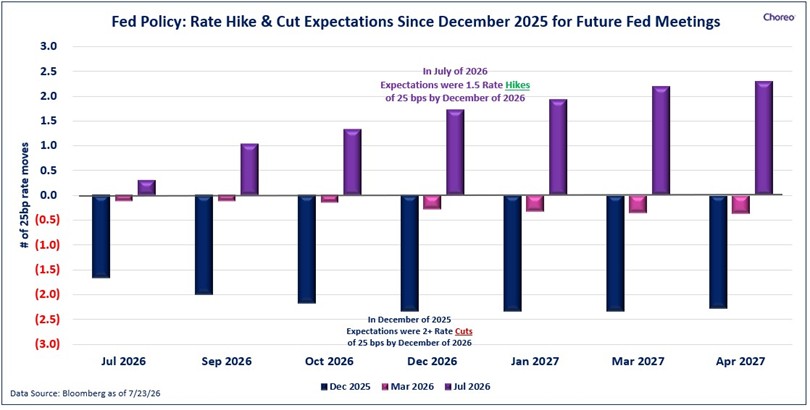
Markets continue to debate the timing—and direction—of the next policy rate move, but the data suggests the Fed has very little reason to rush. A modestly softer labor market may argue for easing, while sticky inflation argues for patience. Those competing forces are likely to keep policy communication in focus and potentially market moving. Market participants entered 2025 with the expectation of multiple interest rate cuts. These expectations have since given way to the elimination of any cuts and markets now forecast the potential for an increase. This has been a dramatic change of expectations and has been a source of volatility. The graph below highlights the change from the beginning of the year.
The leadership transition at the Fed to new Chair Warsh has also caused uncertainty. Leadership changes do not automatically alter policy, but they can influence how markets interpret the reaction function. Put differently, investors may care not only about the next inflation print, but also about how future Fed leadership would respond to it.
European Central Bank
The European Central Bank (the “ECB”) is facing a different set of tradeoffs. Growth has been softer, but inflation risk has not disappeared. While Europe’s labor market, like that of the U.S., remains resilient, the ECB’s mandate is focused on price stability (with employment secondary unlike the Fed which places them both as a dual mandate). Therefore, energy prices and geopolitical developments can matter more for Europe than for the U.S., especially when inflation pressure comes from outside the domestic economy (a significant portion of the region’s energy supplies are imported1, for example). The important point is that Europe’s policy path may not look like the Fed’s. That creates a different backdrop for European equities, European fixed income, and currency exposure for U.S. investors.
Bank of Japan
The Bank of Japan (the “BOJ”) continues to move gradually away from the extremely accommodative policies that defined much of the prior decade. Wage growth, inflation, and currency volatility have all contributed to the slow normalization process that enabled the BOJ to raise policy rates out of negative territory, where they had been for much of the last decade. A gradual change in Japanese policy can affect currency markets and global fixed income flows.
1 Energy in Europe: imports dependency - News articles - Eurostat
Other Developments Worth Watching
The list of market and economic factors is always longer than we can reasonably cover in a single note. A few items, however, seem especially important as we move through the second half of the year:
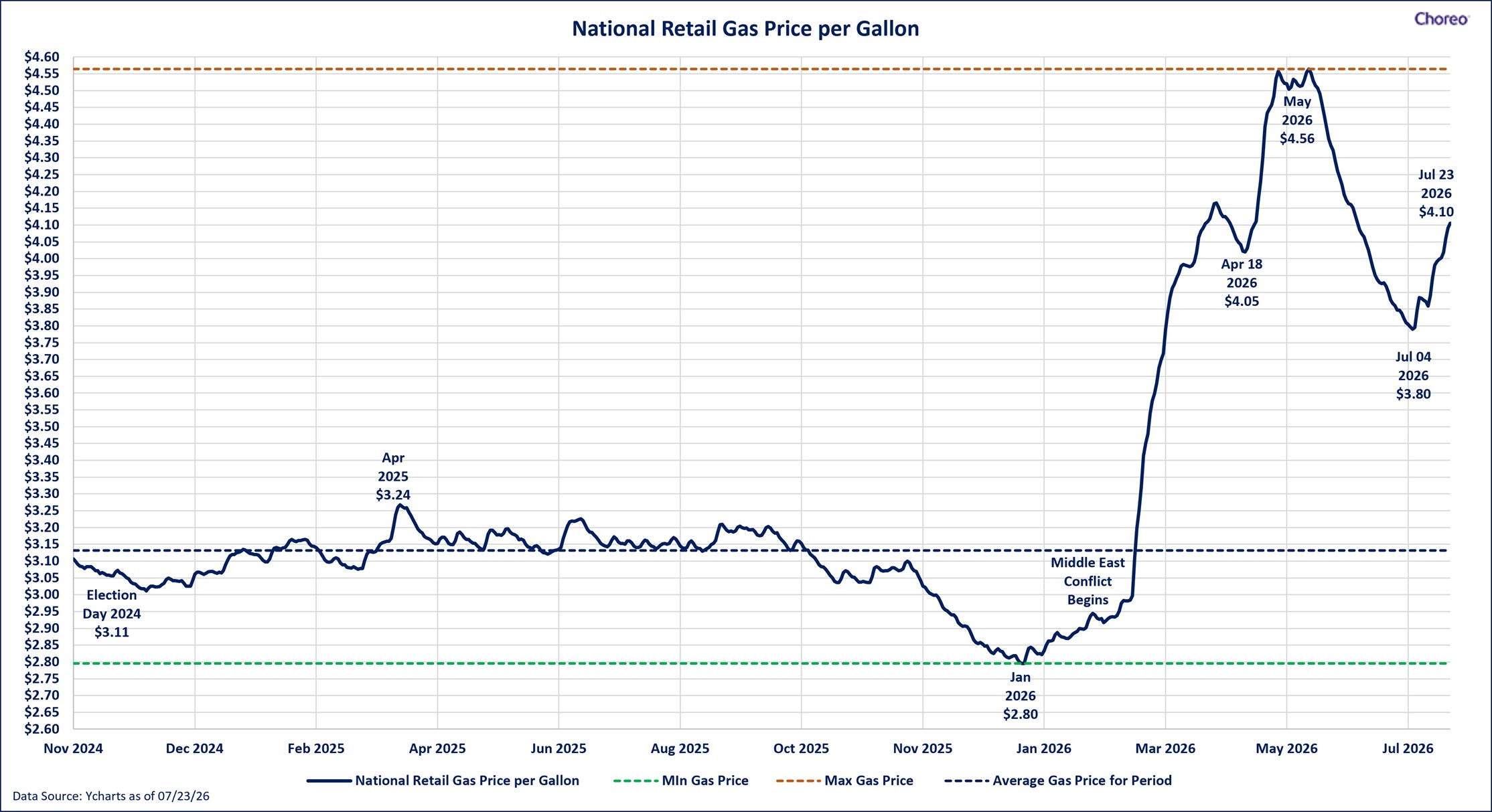
Energy and the Middle East: Oil remains one of the clearest transmission channels from geopolitics to markets. When energy prices rise, the effects can show up in inflation, consumer spending, corporate margins, and central bank policy, among other areas. The immediate risk premium in oil prices has eased modestly from earlier in the year, but it has not disappeared. As the chart below demonstrates, the price consumers pay at the pump is still elevated.
Fixed income positioning: Higher yields continue to create income opportunities and provide a cushion in periods of rate volatility, but tight credit spreads argue for care. Rate movement uncertainty mentioned above, coupled with credit movements could create a more volatile fixed income environment should economic weakness occur.
Mid-term elections: Undoubtedly, politics will enter the top of headlines once again as we approach November. Control of both the House and Senate are potentially up in the air. Future policy will undoubtedly be shaped by the results of these important elections.
Trade Policy: Markets may have forgotten the spring of 2025 when tariff policy dominated headlines, but frequent flare ups are still occurring. Perhaps these are not on the front page of headlines, but trade policy is very much still in the category of items worth watching.
Conclusion
The World Cup analogy is not perfect, but it is useful. In the group stage, the goal is often survival and advancement. In the knockout rounds, the margin for error gets smaller, and the temptation to overreact to every shift in momentum grows. Yet the teams that ultimately win rarely abandon the discipline, preparation, and consistency that brought them that far. They may adjust their formation, make a substitution, or change tactics as the match evolves, but they do not lose sight of the game plan.
Markets require a similar mindset. The second half of the year may bring new headlines, policy uncertainty, leadership changes, and periods of volatility. Long-term investment success is rarely built on reacting to every development in real time. It is more often built on maintaining discipline, staying diversified, and keeping portfolios aligned with the objectives they were designed to serve. A disciplined approach recognizes that uncertainty is part of the investment landscape, and that short-term volatility is not unusual when markets are digesting a wide range of possible outcomes.
As always, our team will continue to monitor these developments and evaluate whether portfolio adjustments are warranted. In the meantime, we believe the most important takeaway is to remain disciplined, focused on long-term objectives, and prepared for a range of market outcomes. Please reach out to your Choreo advisor with any questions.
Important Disclosures
Opinions are as of the date referenced and are based on sources considered reasonable by Choreo. Opinions are subject to change based on market or economic conditions. There is no guarantee that any of these expectations will become actual results.
The performance numbers displayed herein may have been adversely or favorably impacted by events and economic conditions that will not prevail in the future. Past performance does not indicate future performance. The indices discussed are unmanaged and do not incur management fees, transaction costs or other expenses associated with investable products. It is not possible to directly invest in an index.
This document contains general information, may be based on authorities that are subject to change, and is not a substitute for professional advice or services. This document does not constitute audit, tax, consulting, business, financial, investment, insurance, legal or other professional advice, and you should consult a qualified professional advisor before taking any action based on the information herein. Information has been obtained from a variety of sources believed to be reliable though not independently verified. Choreo, LLC, its affiliates and related entities are not responsible for any loss resulting from or relating to reliance on this document by any person. Internal Revenue Service rules require us to inform you that this communication may be deemed a solicitation to provide tax services. This communication is being sent to individuals who have subscribed to receive it or who we believe would have an interest in the topics discussed. Past performance does not indicate future performance. The sole purpose of this document is to inform, and it is not intended to be an offer or solicitation to purchase or sell any security, or investment or service. Investments mentioned in this document may not be suitable for investors. Before making any investment, each investor should carefully consider the risks associated with the investment and make a determination based on the investor’s own particular circumstances, that the investment is consistent with the investor’s investment objectives.
All registered trademarks are intellectual property of Choreo, LLC. © 2026 Choreo, LLC. All Rights Reserved.